


Cancer Stage Aur Grade Mein Kya Difference Hai?
Cancer stage aur grade mein kya difference hai? This is one of the most common questions patients and families have after receiving a biopsy or pathology report.
A cancer report may contain words such as Stage 2, Stage 3, Grade 1, Grade 2, Grade 3, T2, N1 or M0. For someone seeing these terms for the first time, they can be confusing.
The simplest way to understand the difference is:
Cancer stage tells us how far the cancer has spread. Cancer grade tells us how abnormal the cancer cells look and, in many cancers, how aggressively they may behave.
Both provide different information. Neither should be interpreted alone.
Doctors combine stage, grade, cancer type, pathology findings, biomarkers, imaging and the patient's overall health when developing a treatment plan.
Cancer Stage Kya Hota Hai?
Cancer stage describes the extent of cancer in the body.
Doctors want to understand:
Where did the cancer start?
How large is the primary tumour?
Has it grown into nearby tissues?
Are nearby lymph nodes involved?
Has it spread to distant organs?
The answers help determine the extent of the disease.
For many solid tumours, doctors use the TNM staging system.
The National Cancer Institute describes staging as a way of determining how much cancer is present in the body and notes that staging can help doctors plan treatment.
Cancer Grade Kya Hota Hai?
Cancer grade describes how abnormal the cancer cells look under a microscope compared with normal cells.
A pathologist examines the cancer cells and may assess characteristics such as:
How different the cells look from normal cells
How the cells are arranged
How quickly the cells appear to be dividing
Other microscopic features specific to that cancer
The grading system varies between different types of cancer.
In many cancers, lower-grade tumours tend to have cells that look more similar to normal cells, while higher-grade tumours tend to look more abnormal.
However, grade does not mean the same thing as stage.
The pathology report is therefore important because it can provide information about tumour type and grade, while staging usually requires information about the extent of disease.
Stage vs Grade: The Simple Difference
Think of it this way:
| Cancer Stage | Cancer Grade |
|---|---|
| Tells us where the cancer is and how far it has spread | Tells us how abnormal the cancer cells look |
| Usually involves tumour, lymph nodes and distant spread | Determined by microscopic examination of tumour cells |
| Often uses TNM | Grading system varies by cancer |
| Can involve CT, MRI, PET-CT, examination and other tests | Usually determined through pathology |
| Stage 1, 2, 3, 4 are commonly used for many cancers | Grade may be Grade 1, 2, 3 or another cancer-specific system |
| Describes extent of disease | Describes tumour characteristics |
So:
Stage = Extent
Grade = Appearance/characteristics of cancer cells
Example: Why Stage and Grade Are Different
Imagine two patients.
Patient A
The cancer is relatively localized, but the tumour cells look quite abnormal under the microscope.
This patient could have a lower stage but higher grade tumour.
Patient B
The cancer cells may look less abnormal, but the cancer has spread to distant parts of the body.
This patient could have a higher stage but lower grade tumour.
This demonstrates why stage and grade cannot be used interchangeably.
The exact relationship between stage, grade and prognosis depends heavily on the specific cancer type.
What Does Stage 1 Cancer Mean?
Broadly, Stage 1 often indicates a relatively localized cancer.
However, the exact criteria for Stage 1 are different for different cancers.
For example, Stage 1 breast cancer and Stage 1 lung cancer are not necessarily defined in exactly the same way.
Therefore, it is not enough to say:
“Mera cancer Stage 1 hai, so it must be the same as another patient's Stage 1 cancer.”
Your oncologist will interpret the stage according to the specific cancer.
What Does Stage 2 Cancer Mean?
Stage 2 generally represents a cancer that is more extensive than Stage 1, but it does not automatically mean that the cancer has spread to distant organs.
The exact definition can depend on:
Tumour size
Local invasion
Lymph-node involvement
Cancer type
Other disease characteristics
This is why patients should ask their doctor how the stage was determined, rather than relying only on the number.
What Does Stage 3 Cancer Mean?
Stage 3 often indicates more extensive local or regional disease.
Depending on the cancer, it may involve:
A larger tumour
Nearby tissues
Regional lymph nodes
More extensive local disease
However, Stage 3 does not automatically mean distant metastasis.
The exact meaning depends on the cancer-specific staging system.
What Does Stage 4 Cancer Mean?
Stage 4 generally indicates that cancer has spread to distant parts of the body.
This is called metastatic cancer.
For example, depending on the primary cancer, doctors may identify spread to organs such as:
Liver
Lungs
Bones
Brain
Other distant sites
However, Stage 4 does not mean that treatment is impossible.
Treatment options depend on:
Cancer type
Location of metastases
Biomarkers
Previous treatment
Overall health
Symptoms
Tumour biology
Treatment may include chemotherapy, targeted therapy, immunotherapy, hormone therapy, radiation therapy or selected surgical procedures.
Internal link:
Link this section to your future article:
“Stage 4 Cancer Ka Matlab Kya Hai? Kya Stage 4 Cancer Curable Hai?”
What Does Grade 1 Cancer Mean?
In many grading systems, Grade 1 generally indicates that the cancer cells look relatively closer to normal cells compared with higher-grade tumours.
But the exact definition varies by cancer.
A Grade 1 tumour is not automatically harmless.
It is still cancer and requires appropriate medical evaluation and treatment.
What Does Grade 2 Cancer Mean?
Grade 2 is often considered an intermediate grade.
The cells show more abnormal features than Grade 1 but less than a high-grade tumour.
Again, the exact interpretation depends on the cancer type and the grading system used by the pathologist.
What Does Grade 3 Cancer Mean?
Grade 3 generally describes cells that appear more abnormal under the microscope.
In many cancers, higher-grade tumours may behave more aggressively than lower-grade tumours.
However, Grade 3 does not mean Stage 3.
This is an important distinction.
A patient can have:
Stage 1, Grade 3 cancer
Stage 2, Grade 1 cancer
Stage 3, Grade 2 cancer
The combinations depend on the cancer type.
Why Does Cancer Grade Matter?
Grade can provide information about tumour biology.
Depending on the cancer, grade may help doctors understand:
How abnormal the cells appear
How aggressively the tumour may behave
Prognostic information
Whether certain treatment approaches may be appropriate
But grade is only one part of the complete picture.
The doctor may also consider:
Stage
Cancer subtype
Biomarkers
Genetic/molecular features
Patient's overall health
Age
Treatment history
Why Does Cancer Stage Matter?
Stage provides information about the extent of disease.
This is particularly important for treatment planning.
For example, a localized cancer may be considered for treatments aimed at removing or controlling the primary tumour.
A cancer that has spread to distant organs may require a different treatment strategy.
Therefore, knowing the stage helps the oncology team understand the overall disease burden and discuss appropriate treatment options.
Is Stage More Important Than Grade?
There is no universal answer.
Both matter, but they answer different questions.
For many cancers, stage is an important factor in determining treatment and prognosis because it describes the extent of disease.
Grade can also be important because it provides information about the characteristics of the tumour cells.
In some cancers, grade is particularly important.
In others, biomarkers, tumour subtype or other pathological characteristics may have a major influence on treatment decisions.
So it is better not to ask:
“Stage important hai ya grade?”
Instead ask:
“Mere cancer mein stage, grade aur kaunse tumour characteristics treatment ko affect kar rahe hain?”
Can Cancer Stage and Grade Be Found From the Same Biopsy?
Not always.
A biopsy may provide:
Cancer diagnosis
Cancer subtype
Grade
Biomarker information
But the complete stage usually requires additional information.
Depending on the cancer, doctors may use:
CT
MRI
PET-CT
Ultrasound
Endoscopy
Lymph-node evaluation
Physical examination
Other investigations
Therefore:
Biopsy → Diagnosis and pathology information
Staging tests → Extent of disease
These pieces are then combined to develop the overall clinical picture.
Internal link:
Link to:
“Biopsy Ke Baad Cancer Ka Stage Kaise Pata Chalta Hai?”
What Is TNM in a Cancer Report?
You may see terms such as T2 N1 M0 on a medical report.
These letters are part of the TNM staging system used for many cancers.
T — Primary Tumour
T describes the size or local extent of the primary tumour.
N — Lymph Nodes
N describes whether nearby lymph nodes are involved.
M — Metastasis
M describes whether distant spread has been identified.
For example, broadly speaking, M0 indicates no distant metastasis has been identified, while M1 indicates distant metastasis.
The exact criteria for T, N and M categories vary by cancer.
The American Cancer Society explains that TNM is widely used to describe the extent of many cancers.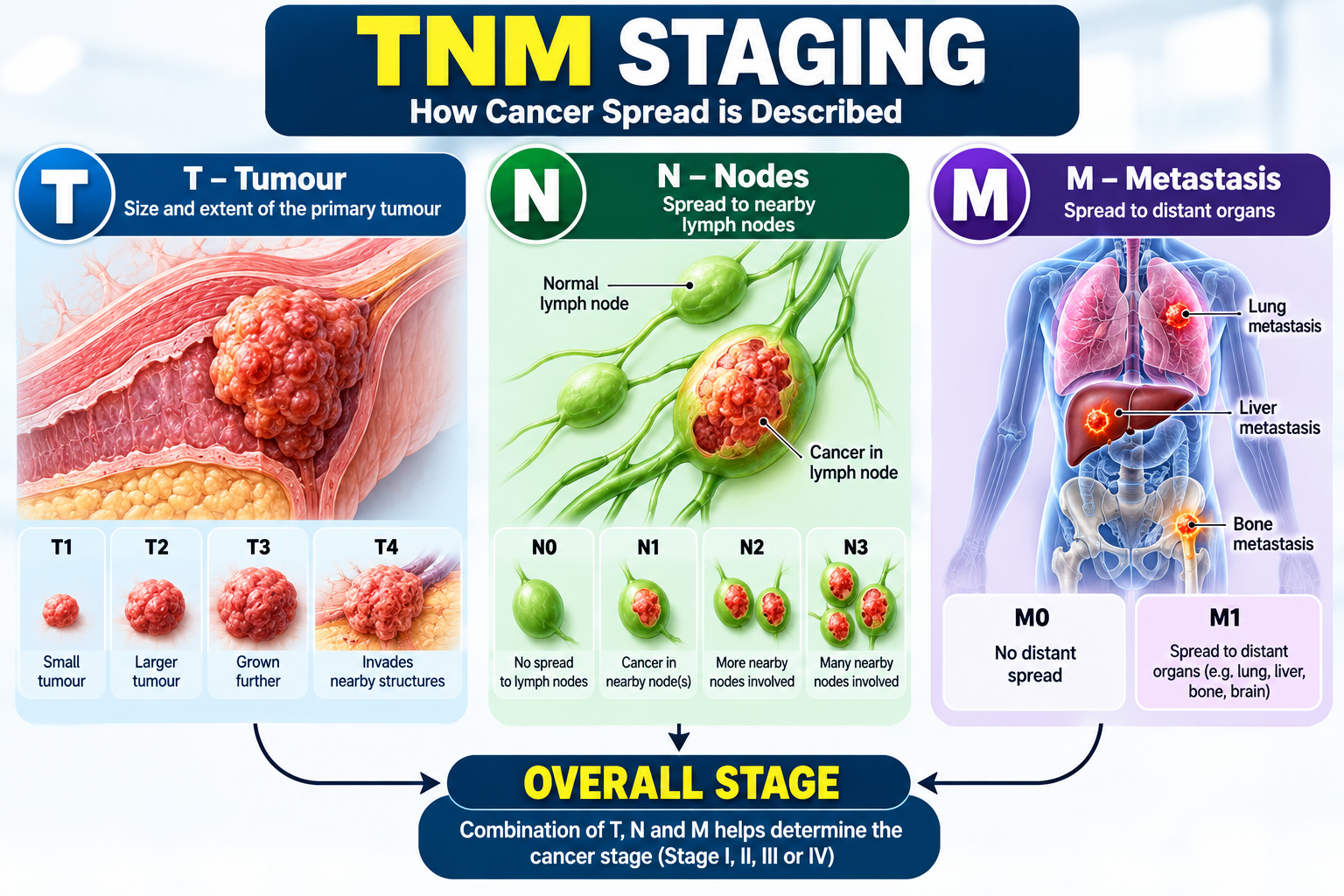
What Is the Difference Between Stage, Grade and Tumour Size?
These three terms are often confused.
Tumour Size
Describes how large the primary tumour is.
Grade
Describes how abnormal the cancer cells appear under a microscope.
Stage
Describes the overall extent of cancer, including factors such as tumour size, lymph-node involvement and distant spread.
A tumour can therefore be:
Small but high-grade
or
Large but lower-grade
or
Small but already metastatic, depending on the cancer.
That is why doctors do not determine treatment using tumour size alone.
Can Cancer Grade Change?
Grade is based on the characteristics observed in the tumour tissue.
In some cancers, additional tissue obtained during surgery may provide more information than an initial small biopsy.
For example, the grade reported from a limited biopsy sample may not always represent every characteristic of a larger tumour.
If the pathology changes after additional tissue examination, your oncologist and pathologist will interpret the findings in context.
Do not compare a preliminary biopsy report with a later surgical pathology report without medical guidance.
Can Cancer Stage Change?
The initial stage describes the extent of cancer when it is evaluated.
Treatment can cause the tumour to shrink or become undetectable on imaging, but this does not simply mean the original stage has changed.
Doctors may instead describe:
Treatment response
Remission
Residual disease
Recurrence
Progressive disease
This terminology is different from the original staging classification.
Why Can Two Patients With the Same Stage and Grade Have Different Treatments?
Because cancer treatment is increasingly individualized.
Two patients may have the same stage and grade but differ in:
Cancer subtype
Biomarker status
Molecular characteristics
Age
Kidney function
Liver function
Other health conditions
Previous treatments
Symptoms
Treatment goals
This is why copying another patient's treatment is not safe.
Your treatment plan should be based on your pathology, staging, overall health and treatment goals.
How Stage and Grade Affect Cancer Treatment
Doctors may consider both stage and grade while developing a treatment plan.
Depending on the cancer, treatment can include:
Surgery
Chemotherapy
Radiation therapy
Immunotherapy
Targeted therapy
Hormone therapy
Combination treatments
Supportive or palliative care
However, the treatment decision is not made from stage or grade alone.
Biomarkers and molecular features can be particularly important for selecting certain modern cancer treatments.
Internal link:
Link to your future article:
“Targeted Therapy Kya Hai Aur Kin Cancer Patients Ko Di Jati Hai?”
If Your Report Says “High Grade,” Should You Panic?
No.
“High grade” is an important medical finding, but it should not be interpreted on its own.
Ask your oncologist:
What exactly does the grade mean in my cancer type?
What is my stage?
Has the cancer spread?
Are any biomarkers relevant?
What treatment options are available?
What is the goal of treatment?
A high-grade cancer can still have different treatment options depending on its stage and biological characteristics.
If Your Report Says “Low Grade,” Does That Mean Treatment Is Not Needed?
No.
Low grade does not mean “no cancer.”
It generally describes the appearance and characteristics of the tumour cells.
Whether treatment is needed and what treatment is appropriate depends on the cancer type, stage, tumour location, symptoms and other factors.
Never stop or postpone recommended cancer treatment because a report says “low grade.”
What Should You Ask Your Doctor About Your Stage and Grade?
Take your pathology report to your oncology appointment and ask:
What is my exact cancer type?
What is my cancer stage?
What is my tumour grade?
How was the stage determined?
Does my pathology report require additional testing?
Do I need biomarker or molecular testing?
Are my lymph nodes involved?
Has the cancer spread to distant organs?
How do my stage and grade affect treatment?
What is the goal of my treatment?
Writing these questions down before the appointment can help you understand your diagnosis more clearly.
Looking for the Right Cancer Specialist in Lucknow?
After reading a pathology report, many families search for the best oncologist in Lucknow or the best cancer hospital in Lucknow.
Rather than selecting a hospital based only on online rankings, look for a cancer-care team that can evaluate your complete case—including pathology, imaging, stage, grade and relevant biomarkers.
Cancer care may involve different specialists, including:
Surgical oncologists
Medical oncologists
Radiation oncologists
Pathologists
Radiologists
Other specialist doctors and supportive-care professionals
A coordinated approach can help ensure that treatment decisions are based on the complete clinical picture.
Internal link:
Link “Cancer Treatment Services in Lucknow” to Karuna Cancer Centre's services page.
Final Takeaway
The easiest way to remember the difference is:
Stage = How far has the cancer spread?
Grade = How abnormal do the cancer cells look?
A biopsy can provide important information about the cancer type and grade, but complete staging often requires additional evaluation such as imaging and lymph-node assessment.
Neither stage nor grade should be interpreted in isolation.
Your oncology team may consider:
Cancer type + Stage + Grade + Biomarkers + Molecular characteristics + Overall health
before recommending treatment.
If you have recently received a pathology report and are confused by terms such as Stage 2, Grade 3, T2, N1 or M0, take the complete report to an oncology specialist rather than trying to interpret individual numbers yourself.
At Karuna Cancer Centre & Research Institute, Lucknow, patients can discuss their pathology reports, staging investigations and treatment options with an oncology team and understand what their diagnosis means for the next stage of care.
Medical disclaimer: This article is for general educational purposes and does not replace consultation with a qualified medical professional. Cancer staging and grading systems differ between cancer types. Your treating oncologist and pathologist should interpret your individual report.
Frequently Asked Questions
1. Cancer stage aur grade mein kya difference hai?
Cancer stage tells you how far the cancer has spread in the body, while grade describes how abnormal the cancer cells look under a microscope. Both provide different information.
2. Kya Stage 3 aur Grade 3 same hota hai?
No. Stage 3 and Grade 3 are completely different concepts. Stage describes the extent of cancer, while grade describes the characteristics of the cancer cells.
3. Kya biopsy report se cancer ka grade pata chalta hai?
Often, yes. A pathology examination of biopsy tissue can provide information about tumour grade when grading is applicable to that cancer. However, the grading system varies between cancer types.
4. Kya biopsy report se cancer ka stage pata chalta hai?
Not necessarily. Biopsy can confirm cancer and provide important pathological information, but complete staging may require physical examination, imaging, lymph-node evaluation and other investigations.
5. Stage 1 cancer ka kya matlab hota hai?
Stage 1 generally represents relatively localized disease, but the exact definition varies by cancer type. Your oncologist should explain what Stage 1 means specifically for your cancer.
6. Stage 4 cancer ka kya matlab hota hai?
Stage 4 generally indicates that cancer has spread to distant parts of the body. Treatment may still be possible depending on cancer type, tumour biology, location of spread and the patient's overall health.
7. High-grade cancer kya hota hai?
High-grade cancer generally contains cells that look more abnormal under microscopic examination. In many cancers, higher grade may be associated with more aggressive tumour behaviour, but its meaning depends on the specific cancer.
8. Low-grade cancer kya hota hai?
Low-grade cancer generally has cells that appear more similar to normal cells under the microscope. It is still cancer and may require treatment depending on the cancer type and stage.
9. Kya high-grade cancer ka matlab Stage 4 hota hai?
No. A cancer can be high grade but early stage, or lower grade but more advanced stage. Grade and stage measure different characteristics.
10. Kya cancer ka stage treatment ke baad change hota hai?
Treatment can reduce the amount of visible cancer, but doctors generally distinguish the original stage from treatment response, remission, recurrence or progression.
11. Kya same stage ke cancer ka treatment same hota hai?
No. Treatment can differ because of cancer subtype, biomarkers, molecular characteristics, tumour location, patient's overall health and previous treatment.
12. TNM staging kya hoti hai?
TNM is a commonly used system in which T describes the primary tumour, N describes nearby lymph nodes and M describes distant metastasis. The exact criteria vary by cancer type.
13. Cancer stage determine karne ke liye kaunse tests hote hain?
Depending on the cancer, doctors may use CT, MRI, PET-CT, ultrasound, endoscopy, lymph-node evaluation and other investigations along with pathology and clinical examination.
14. Kya cancer grade treatment decide karta hai?
Grade can contribute to treatment planning, but treatment decisions usually consider multiple factors, including stage, cancer type, biomarkers, molecular characteristics and the patient's overall health.
15. Cancer report samajh nahi aa rahi to kya karein?
Don't try to interpret isolated terms or numbers yourself. Take the complete pathology and imaging records to an oncology specialist and ask the doctor to explain the cancer type, stage, grade and treatment options.