

Biopsy Ke Baad Cancer Ka Stage Kaise Pata Chalta Hai?
Biopsy ke baad cancer ka stage kaise pata chalta hai? This is one of the first questions many patients and families ask after receiving a cancer diagnosis.
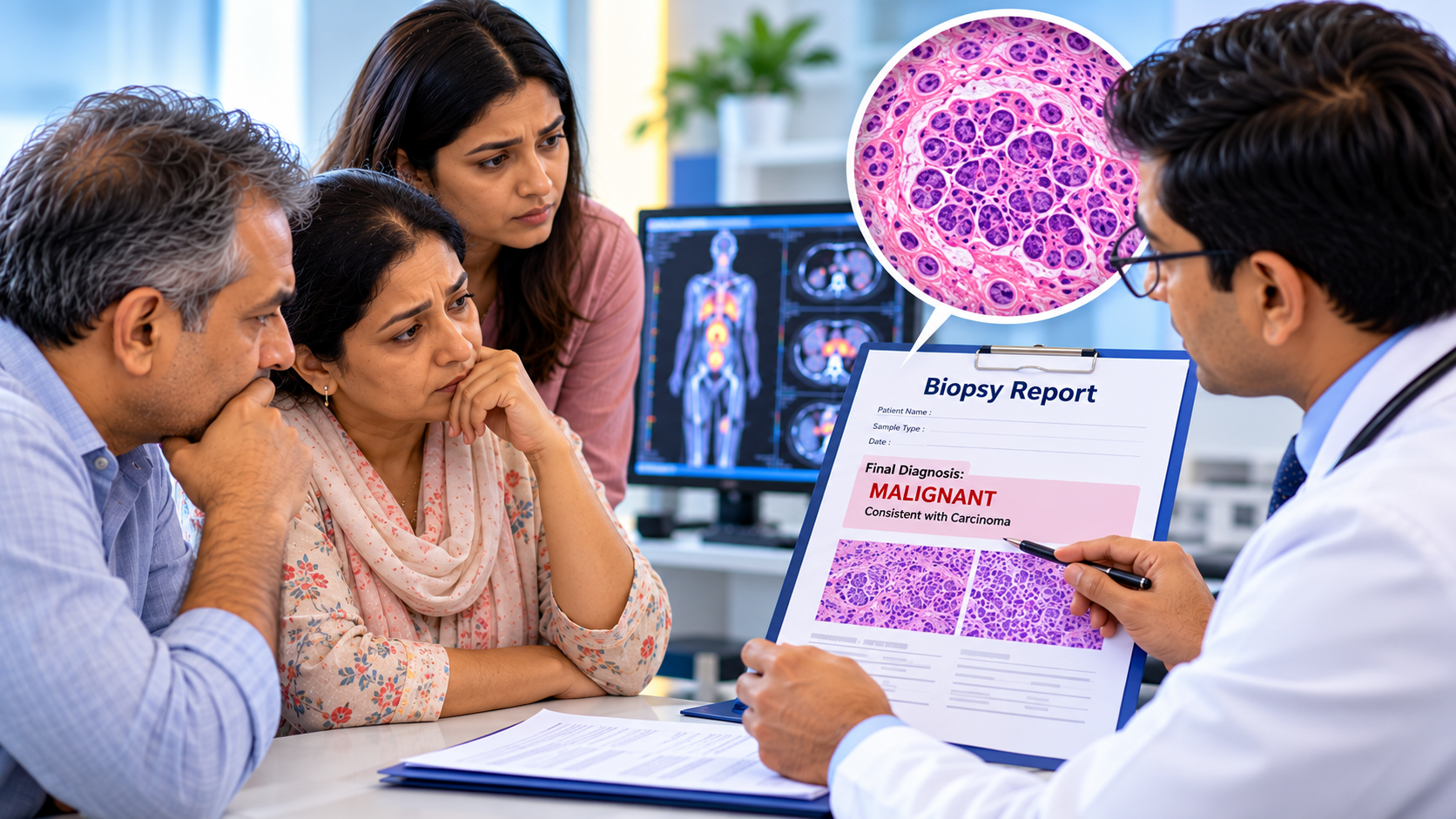
A biopsy can confirm that cancer is present and can provide important information about the type and characteristics of the cancer. However, biopsy alone usually does not tell the complete stage of a cancer.
To determine the stage, doctors combine information from the pathology report with the patient's examination, imaging scans, laboratory tests and, in some cases, additional procedures.
The purpose of staging is to understand how much cancer is present, where it is located and whether it has spread to nearby lymph nodes or other parts of the body. This information helps the oncology team plan appropriate treatment.
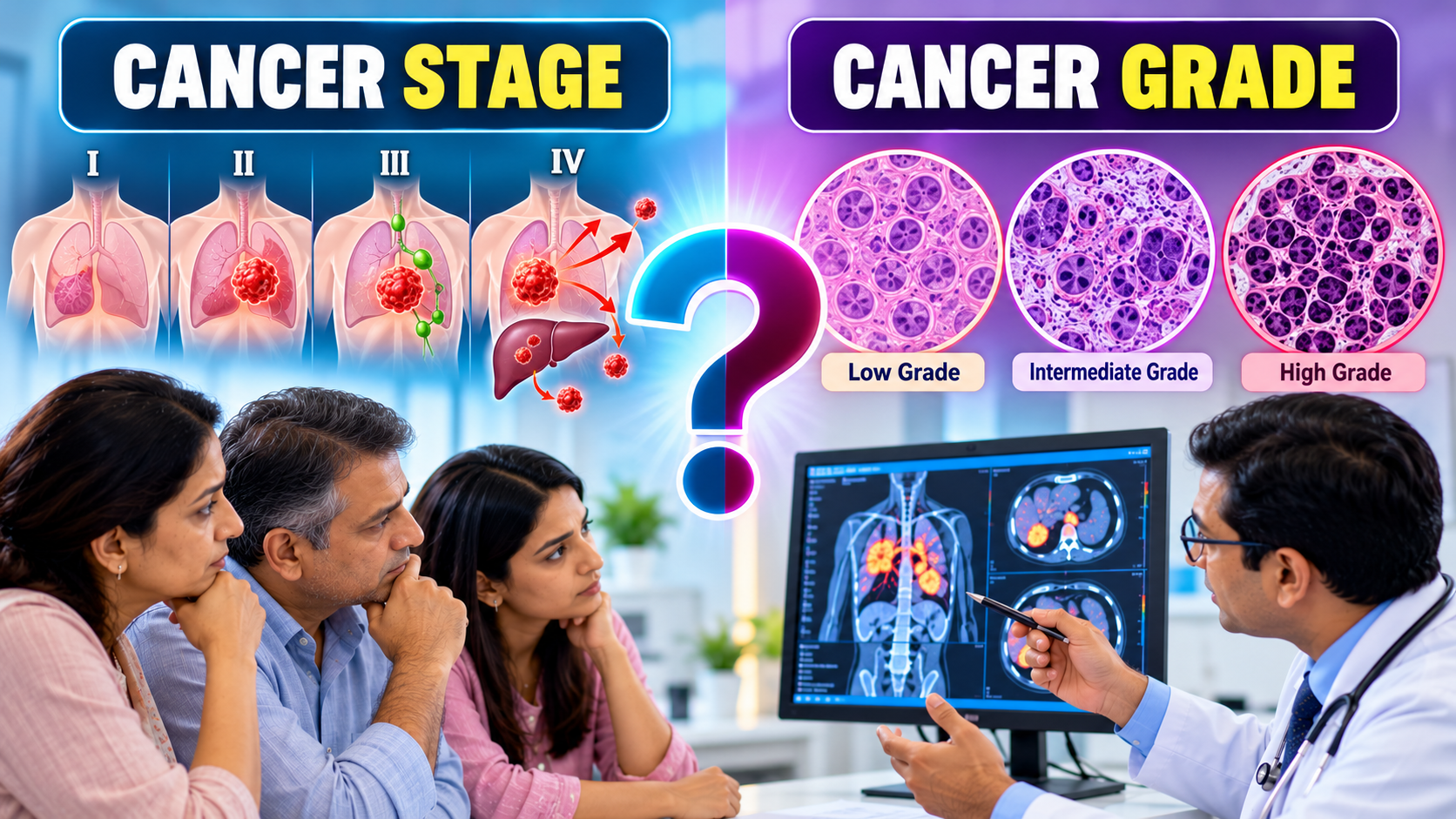
What Does “Cancer Stage” Mean?
Cancer stage describes the extent of cancer in the body.
In simple terms, doctors want to know:
Where did the cancer start?
How large is the primary tumour?
Has it grown into nearby tissues?
Are nearby lymph nodes involved?
Has it spread to distant organs?
How extensive is the disease overall?
Staging is important because cancers at different stages may require different treatment approaches.
For many solid cancers, doctors use a system called TNM staging. The exact staging system and criteria can vary depending on the type of cancer.
The National Cancer Institute explains that cancer staging helps describe the extent of cancer and can help doctors plan treatment and estimate prognosis.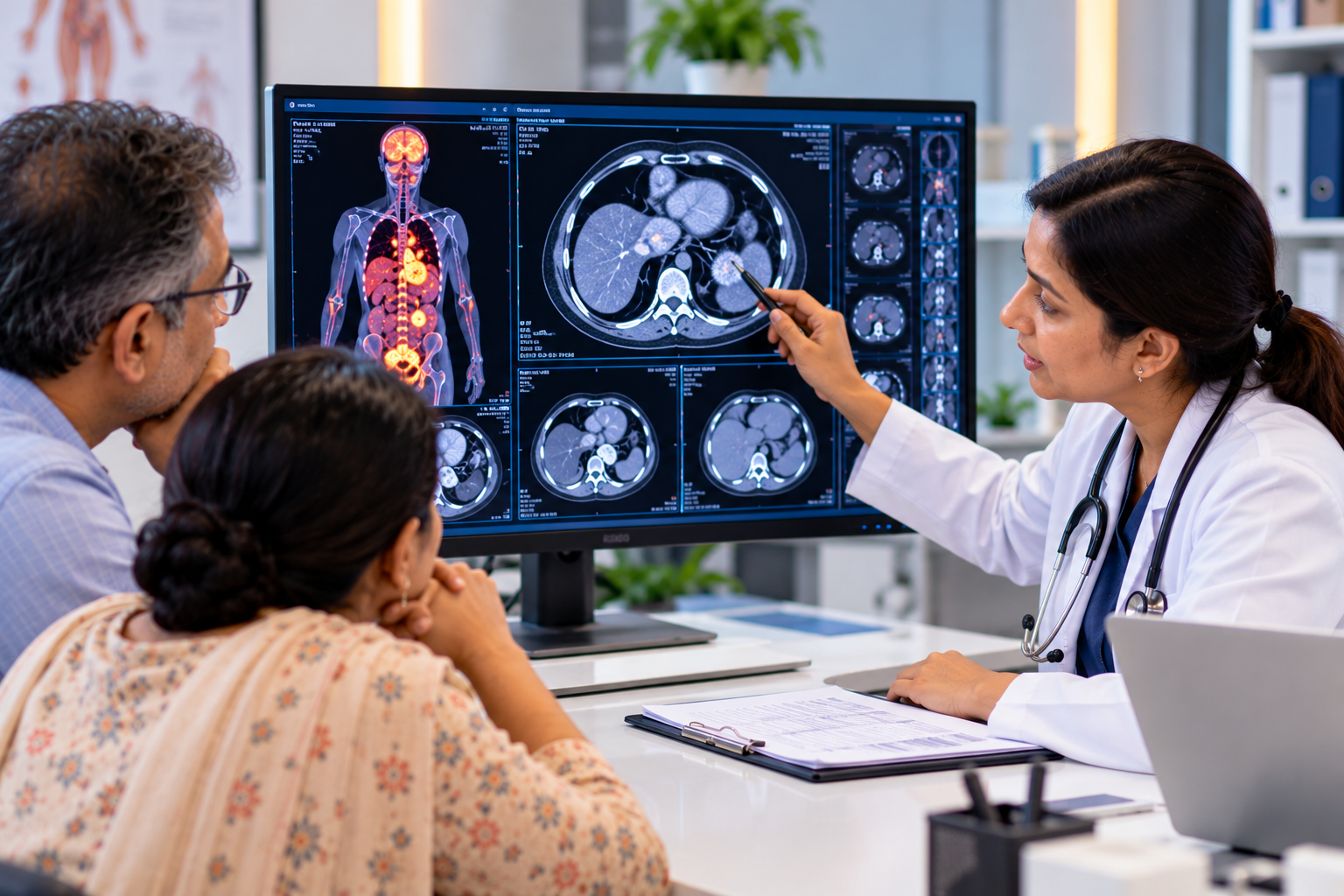
Does a Biopsy Tell the Cancer Stage?
Not always.
This is one of the most important things to understand.
A biopsy examines a sample of tissue and can help establish the diagnosis. It may provide information about:
Cancer type
Histological subtype
Tumour grade
Certain biomarkers
Other characteristics of the tumour
But a small tissue sample generally cannot tell the doctor the complete extent of cancer throughout the body.
For example, a biopsy may confirm that a tumour is cancerous, but it may not tell whether cancer has reached:
Nearby lymph nodes
The lungs
Liver
Bones
Brain
Other distant organs
That is why additional evaluation may be required.
Internal link:
Link the phrase “Biopsy Report Mein Cancer Aa Gaya — Ab Sabse Pehle Kya Karna Chahiye?” to your previous article.
How Is Cancer Stage Determined After a Biopsy?
Doctors usually combine several pieces of information.
The process may look like:
Biopsy → Pathology → Clinical examination → Imaging → Lymph-node evaluation → Additional tests → Staging → Treatment planning
The exact process differs according to the type of cancer.
Let's understand each part.
1. Pathology Report
The pathology report is an important starting point.
It may identify:
Type of cancer
Histological subtype
Grade
Certain tumour characteristics
Lymph-node findings, if lymph nodes were sampled
Biomarker information, when applicable
The pathology report helps doctors understand what the cancer is.
But staging requires understanding where the cancer is and how far it has spread.
That is why pathology is combined with other information.
2. Physical Examination
Your doctor may perform a detailed clinical examination.
Depending on the cancer, this can include checking:
Size or location of a lump
Nearby lymph nodes
Abdominal findings
Neck swelling
Oral lesions
Breast findings
Skin changes
Neurological symptoms
Other symptoms relevant to the cancer
Physical examination alone cannot determine the complete stage in most cancers, but it provides important information that helps guide further investigations.
3. CT Scan for Cancer Staging
A CT scan uses X-rays and computer processing to create detailed images of structures inside the body.
Depending on the cancer, CT may help doctors assess:
The primary tumour
Nearby tissues
Lymph nodes
Chest
Abdomen
Pelvis
Other areas where cancer may have spread
The need for CT depends on the cancer type and the clinical question the doctor needs to answer.
Internal link:
Link to the upcoming article:
“PET-CT Aur CT Scan Mein Kya Difference Hai?”
4. MRI for Cancer Staging
MRI uses magnetic fields and radio waves to create detailed images.
It can be particularly useful when doctors need detailed information about soft tissues.
Depending on the cancer, MRI may help evaluate areas such as:
Brain
Spine
Pelvis
Liver
Soft tissues
Certain locally advanced tumours
MRI is not required for every cancer patient.
The treating specialist decides whether it will provide information that could affect staging or treatment.
5. PET-CT and Cancer Staging
Patients often ask:
“Cancer diagnose hone ke baad PET-CT kyun karwaya ja raha hai?”
A PET-CT combines metabolic information from PET with anatomical information from CT.
Depending on the cancer, PET-CT can help identify areas of increased metabolic activity and may help determine whether cancer has spread to other parts of the body.
However, PET-CT is not automatically required for every cancer patient.
Its usefulness depends on:
Cancer type
Suspected stage
Symptoms
Previous imaging
Treatment planning
The specific clinical question
Internal link:
Link “PET-CT Se Pehle Kya Khana Chahiye?” to your PET-CT preparation article.
6. Lymph Nodes Are Important in Cancer Staging
You may hear your doctor mention lymph nodes during a cancer consultation.
Lymph nodes are small structures that form part of the lymphatic system.
Some cancers can spread from the primary tumour to nearby lymph nodes.
Doctors may evaluate lymph nodes through:
Imaging
Needle biopsy
Surgical sampling
Lymph-node dissection
Sentinel lymph-node procedures in selected cancers
If cancer cells are found in lymph nodes, this information may affect the stage and treatment plan.
However, lymph-node involvement does not automatically mean Stage 4 cancer.
The significance depends on the cancer type and the exact pattern of spread.
What Is TNM Staging?
For many solid cancers, doctors use the TNM system.
T = Tumour
T describes the size and/or extent of the primary tumour.
Depending on the cancer, T may be divided into categories such as:
T1
T2
T3
T4
The exact meaning of each category depends on the cancer type.
N = Nodes
N describes whether nearby lymph nodes contain cancer and, depending on the cancer, how many or which nodes are involved.
Categories may include:
N0
N1
N2
N3
Again, the definitions vary by cancer type.
M = Metastasis
M describes whether cancer has spread to distant parts of the body.
Broadly:
M0 means no distant metastasis has been identified.
M1 indicates distant metastasis.
The TNM information can then be used with other cancer-specific criteria to determine an overall stage.
The American Cancer Society explains that TNM is a commonly used cancer staging system in which T describes the primary tumour, N describes nearby lymph nodes and M describes distant metastasis.
What Do Stage 1, Stage 2, Stage 3 and Stage 4 Mean?
Patients often want a simple explanation of the stages.
Broadly:
Stage 1
Often represents a relatively localized cancer, although the exact definition varies by cancer type.
Stage 2
May represent a larger tumour or more locally advanced disease than Stage 1.
Stage 3
Often involves more extensive local disease and/or regional lymph-node involvement.
Stage 4
Generally indicates that cancer has spread to distant parts of the body, known as metastatic cancer.
However, these are general descriptions.
A Stage 2 breast cancer and a Stage 2 lung cancer do not necessarily have the same characteristics or treatment.
Even within one cancer type, staging criteria can be complex.
Therefore, don't compare your stage with another patient's stage without understanding the exact cancer type.
Is Stage 4 Cancer Always Untreatable?
No.
This is an important myth to address.
Stage 4 generally means that cancer has spread to distant parts of the body. However, treatment may still be possible.
Depending on the cancer, treatment may include:
Chemotherapy
Immunotherapy
Targeted therapy
Hormone therapy
Radiation therapy
Surgery in selected situations
Combinations of different treatments
Supportive and palliative care
The goal of treatment depends on the cancer type, extent of disease, tumour biology, patient's overall health and available treatment options.
Some metastatic cancers can be controlled for significant periods with modern treatments.
Therefore, a Stage 4 diagnosis should be discussed with an oncology team rather than interpreted as “nothing can be done.”
Can Cancer Stage Change After Treatment Starts?
The initial stage is generally determined based on the disease extent at diagnosis.
Treatment can change the amount of cancer visible on scans, but this does not necessarily mean that the original stage simply changes.
Doctors may use terms such as:
Clinical stage
Pathological stage
Treatment response
Remission
Recurrence
Progressive disease
These terms have different meanings.
For example, a patient may receive chemotherapy before surgery. The treatment may significantly shrink the tumour, and the surgical pathology may provide additional information about the cancer.
This is one reason why cancer staging can sometimes seem confusing.
Clinical Stage vs Pathological Stage
You may hear your doctor use these terms.
Clinical Stage
This is based on information available before definitive treatment, such as:
Physical examination
Imaging
Biopsy
Endoscopy
Other diagnostic tests
It is often written as cTNM.
Pathological Stage
This may be determined after surgery when the removed tumour and/or lymph nodes can be examined by a pathologist.
It may be written as pTNM.
Not every patient undergoes surgery, so pathological staging is not applicable in every case.
Why Can Two Patients With the Same Cancer Stage Receive Different Treatments?
This is another common question.
Suppose two patients are both diagnosed with Stage 3 cancer.
Their treatment may still differ because of:
Cancer subtype
Tumour location
Biomarker results
Genetic characteristics
Patient's age
Overall health
Kidney or liver function
Previous treatment
Other medical conditions
Patient preferences
Response to treatment
Therefore:
Stage is important, but it is not the only factor that determines treatment.
Cancer treatment is increasingly personalized according to both the extent of disease and the biological characteristics of the tumour.
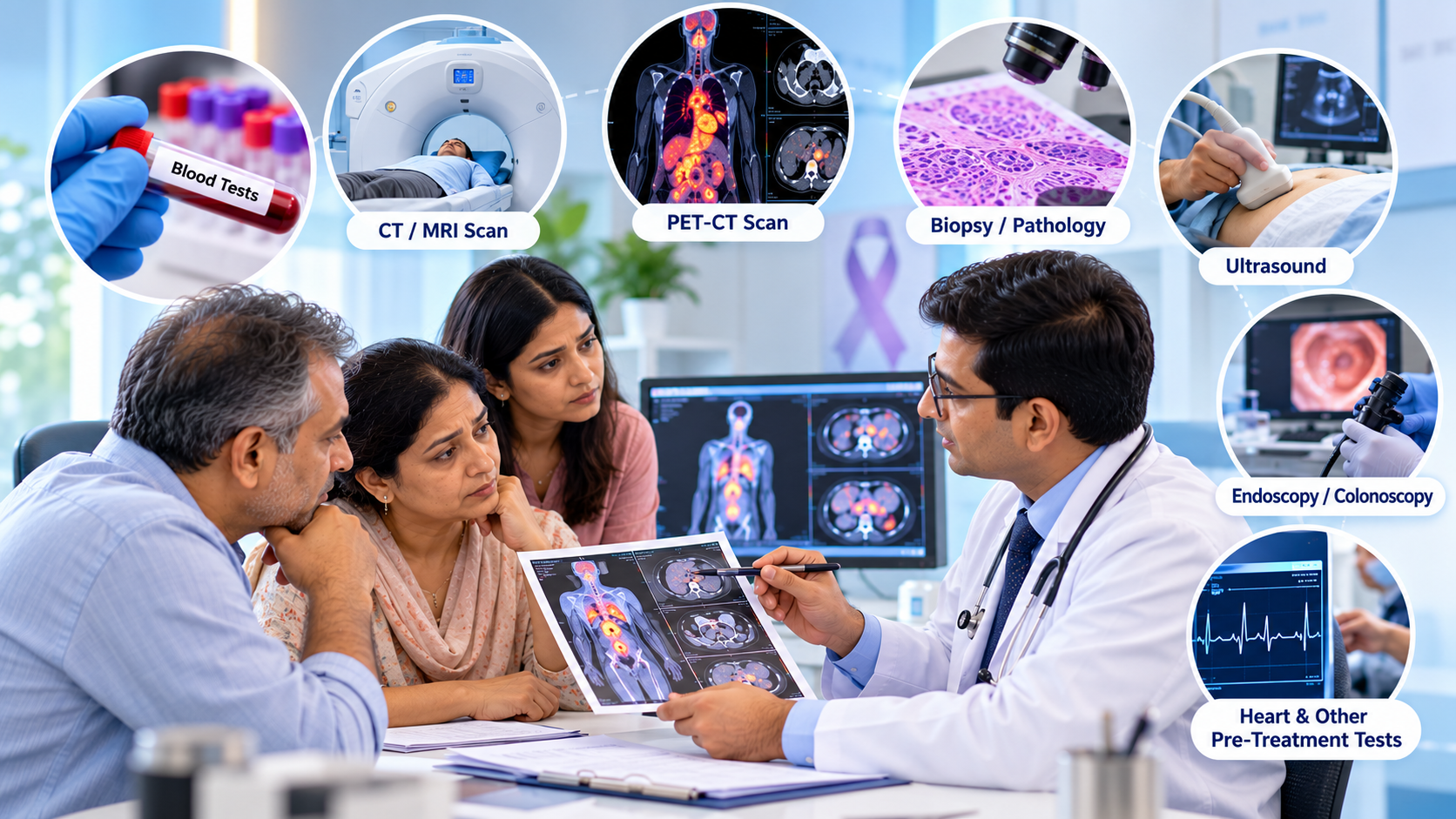
What Tests May Be Needed to Determine Cancer Stage?
Depending on the cancer, doctors may recommend:
| Test | Why it may be used |
|---|---|
| Biopsy | Confirm cancer and identify tumour type |
| Pathology review | Understand tumour characteristics |
| CT scan | Evaluate tumour and possible spread |
| MRI | Detailed soft-tissue imaging |
| PET-CT | Evaluate metabolic activity and possible spread in selected cancers |
| Ultrasound | Evaluate specific organs or areas |
| Endoscopy | Examine internal organs and obtain tissue when needed |
| Lymph-node evaluation | Determine regional involvement |
| Blood tests | Assess overall health and selected clinical markers |
| Biomarker testing | Help guide treatment in selected cancers |
Important: This does not mean every patient needs all these tests.
Your doctor chooses investigations according to your individual diagnosis.
How Long Does Cancer Staging Take?
There is no single timeframe for every patient.
Some patients already have enough information from their initial biopsy and imaging to begin treatment planning quickly.
Others may require:
Additional imaging
Pathology review
Biomarker testing
Additional biopsy
Specialist consultations
Pre-treatment medical evaluation
It is important to complete the investigations recommended by your oncology team without unnecessary delays.
At the same time, don't undergo multiple tests simply because someone else with cancer had them.
What Should You Carry to Your Staging Consultation?
Keep all reports together.
Carry:
Original biopsy report
Pathology slides/blocks if available
CT/MRI/PET-CT reports
Actual scan images
Blood tests
Previous prescriptions
Hospital discharge summaries
Previous treatment records
Current medication list
Relevant family history
Having complete records can make it easier for the oncology team to review the case.
8 Questions to Ask Your Oncologist About Cancer Staging
Before leaving the consultation, ask:
What is my exact cancer type?
What is my current stage?
How was the stage determined?
Has the cancer spread to lymph nodes?
Has it spread to another organ?
Do I need PET-CT, CT or MRI?
Do I need any additional biopsy or biomarker tests?
How does my stage affect my treatment options?
If you understand these eight points, the treatment discussion becomes much easier.
Looking for Cancer Care in Lucknow?
After receiving a cancer diagnosis, patients and families often search for the best cancer hospital in Lucknow or the best oncologist in Lucknow.
When choosing a cancer centre, don't rely only on online rankings or advertisements.
Consider whether the centre can provide access to the relevant oncology specialties, diagnostic evaluation, pathology review, imaging, surgery, medical oncology, radiation oncology and supportive care required for your cancer.
For a newly diagnosed patient, it is particularly important that diagnosis, staging and treatment planning are connected.
Internal link:
Link “Cancer Treatment Services in Lucknow” to Karuna Cancer Centre's relevant services page.
Final Takeaway
A biopsy can confirm cancer, but the complete cancer stage is usually determined by combining pathology with clinical examination, imaging and other relevant investigations.
The process may involve:
Biopsy → Pathology → Examination → Imaging → Lymph-node evaluation → Additional tests → TNM assessment → Overall stage → Treatment planning
Remember that not every patient needs every test.
If you have recently received a cancer diagnosis, don't try to determine your stage from the biopsy report alone. Discuss the report and recommended investigations with an oncology specialist.
Understanding the stage can help you understand the disease and the available treatment options, but stage is only one part of the complete cancer-treatment picture.
At Karuna Cancer Centre & Research Institute, Lucknow, patients can discuss their pathology reports, imaging and treatment options with an oncology team and understand the next steps in their cancer-care journey.
Medical disclaimer: This article is for general educational purposes and does not replace medical consultation or individualized cancer treatment advice. Cancer staging systems differ between cancer types. Your treating oncology team should interpret your reports and determine your individual stage.
Frequently Asked Questions
1. Biopsy ke baad cancer ka stage kaise pata chalta hai?
Biopsy cancer ka type aur characteristics identify karne mein help karti hai, lekin complete stage determine karne ke liye doctors pathology, physical examination, CT/MRI/PET-CT, lymph-node evaluation aur other relevant tests ko combine kar sakte hain.
2. Kya biopsy report mein cancer ka stage likha hota hai?
Har biopsy report mein complete cancer stage nahi hota. Stage determine karne ke liye cancer ki location, tumour size, lymph nodes aur possible spread ki information bhi zaroori ho sakti hai.
3. Cancer ka stage pata karne ke liye kaunsa scan hota hai?
Cancer ke type ke according CT, MRI, PET-CT, ultrasound ya other imaging tests use kiye ja sakte hain. Har patient ko PET-CT ya har scan ki zarurat nahi hoti.
4. PET-CT se cancer ka stage pata chalta hai kya?
Selected cancers mein PET-CT doctors ko disease ki extent aur possible spread evaluate karne mein help kar sakta hai. Lekin PET-CT ki requirement cancer type aur clinical situation par depend karti hai.
5. TNM staging kya hoti hai?
TNM ek commonly used staging system hai. T primary tumour ke size/extent, N nearby lymph nodes aur M distant metastasis ko describe karta hai.
6. Kya lymph node mein cancer milna Stage 4 hota hai?
Nahi. Nearby lymph nodes mein cancer milna automatically Stage 4 nahi hota. Stage cancer type aur disease ke exact extent par depend karta hai.
7. Stage 4 cancer ka matlab kya hota hai?
Stage 4 generally indicates that cancer has spread to distant parts of the body. However, treatment may still be available, depending on the cancer type, extent, tumour biology and patient's overall health.
8. Kya Stage 4 cancer ka treatment ho sakta hai?
Haan, many Stage 4 cancers can be treated. Depending on the cancer, treatment may include chemotherapy, immunotherapy, targeted therapy, hormone therapy, radiation or surgery in selected situations.
9. Clinical stage aur pathological stage mein kya difference hai?
Clinical stage treatment se pehle available information—such as examination, imaging and biopsy—par based hota hai. Pathological stage surgery ke baad removed tissue aur lymph nodes ki microscopic examination se additional information provide kar sakta hai.
10. Kya cancer stage treatment ke baad change ho jata hai?
Treatment ke baad tumour shrink ya disappear ho sakta hai, lekin iska matlab automatically yeh nahi hota ki original stage change ho gaya. Doctors treatment response, remission, recurrence aur progression jaise separate terms use karte hain.
11. Kya same stage ke cancer patients ka treatment same hota hai?
Nahi. Treatment cancer type, subtype, biomarkers, tumour location, patient's overall health, previous treatment and other factors ke according personalize kiya ja sakta hai.
12. Cancer stage pata chalne mein kitna time lagta hai?
Time cancer type aur required investigations par depend karta hai. Kuch patients mein initial reports se sufficient information mil sakti hai, while others may require additional imaging, pathology review or biomarker testing.
13. Cancer staging ke liye blood test enough hota hai?
Usually, blood tests alone cancer ka complete stage determine nahi karte. Doctors blood tests ko pathology, examination and imaging ke saath interpret karte hain.
14. Cancer diagnosis ke baad second opinion lena chahiye?
A second opinion can be useful when the diagnosis or treatment is complex, major surgery is being considered, or the patient wants additional clarity about available treatment options. Complete pathology and imaging records should be taken to the second consultation.